


Are you interested in helping improve horse or pet interactions with their owners? A career as an animal behaviorist may be the career path for you. Find out with the perspective of animal behaviorist Karen Holman.
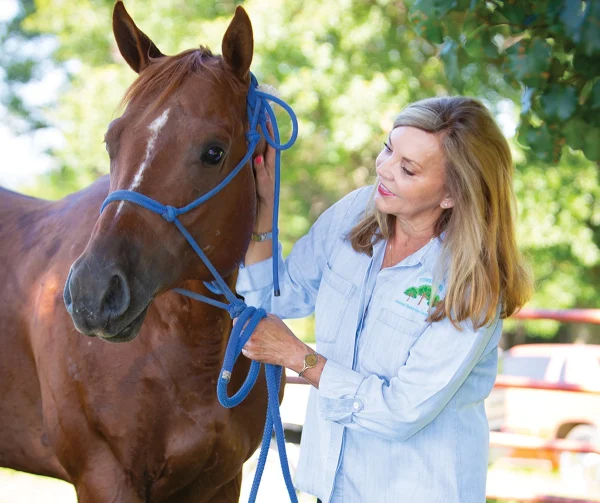
Growing up in rural Oklahoma, Karen developed a deep fondness for animals, especially since her parents and grandparents were also animal lovers. As a child, Karen and her sisters participated in 4-H, where they learned a great deal about horses. Early on, she enjoyed observing animals and how they communicated with one another and humans.
Karen went on to become a science and health teacher, but she eventually decided to start a side business where she would be able to follow her passion of helping animals in need.
A New Path
After Karen adopted a Labrador Retriever with a biting problem about 15 years ago, many people told her that the dog should be euthanized and to start over with another dog. Karen and her family, however, were committed to helping their new pet while also providing a safe environment for everyone in their home.

Karen sought the help of her veterinarian, Charles McWilliams, DVM, as well as Carlos Siracusa, DVM, Ph.D., at the University of Pennsylvania-Ryan Veterinary Hospital Behavior Clinic and, in time, learned how to change her dog’s aggressive behavior.
Because of that experience, Karen was inspired to attend graduate school and become an animal behavior consultant. She has now been consulting professionally since 2015 at her business, Three Oaks Animal Behavior Counseling.
Working with dogs, cats, and horses, Karen often observes animals in their environment before providing positive treatment interventions to help improve the bond between owner and pet.
Helping Horses as an Animal Behaviorist
With horses, Karen is often asked to help with behaviors such as aggression, abnormal eating habits, fears and phobias, as well as undesirable stall behaviors.
“Managing a horse’s environment is a large piece of the puzzle,” she says. “Many of the problems I see in this area are horses that are confined to a stall too many hours in a day and not allowed to forage for food. The lack of appropriate forage time, environmental enrichment, and stimulation can lead to stereotypic behaviors or repetitive actions.”
Karen explains that what she does as an animal behavior consultant is different from what horse trainers do. She doesn’t train people to ride or train horses for riding, though she may give owners tips about positive approaches when working with or riding their horses. Karen mainly teaches people how to reduce inappropriate behaviors in their pets and replace them with more appropriate behaviors.
Karen says that she also works with horses who have problems with the horse trailer, ear-trimming, or have difficulty with medical procedures, but says that the longer an inappropriate behavior is allowed to continue, the more difficult it tends to be to change.
“You cannot punish behaviors out of them,” she says, going on to tell a story with her childhood horse, Twister, in which a farrier injured the horse’s nose with a twitch, leading to the necessity of veterinary care.
Twister did not learn anything from that experience except extreme fear. He was fearful from that event for many years.
“I never forgot the look in his eyes,” she recalls. “I felt as if he depended on me to protect him and I failed him. That was a pivotal moment in my path to studying the science behind animal behavior.”
Three Techniques
Depending on the species she is working with, as well as the individual animal’s needs, Karen uses different approaches. Two things she always keeps in mind when working with horses are their size and the fact that they are prey animals and not predators, like dogs and cats.
“[Horses] are very likely to escape from a fearful situation,” she says. “This can lead to unsafe situations for riders and to unsuspecting humans.”
Karen also explains that there are some similarities in working with animals, no matter the species, and that behavior is often changed by using three main techniques:
1. Counter conditioning, where the goal is to change an animal’s emotional response, feelings, or attitude toward a triggering event.
2. Operant learning, where behavior is changed through positive reinforcement or punishment.
3. Desensitization, a technique often used in treating phobias (fears), where the animal is repeatedly exposed to the triggering event in order to reduce his fear.
Karen says that understanding what is normal behavior for each type of animal is extremely important in her work.
“I am always gentle and soft-spoken, providing ample positive reinforcement [of praise and high-value treats],” she says. “I respect the animals I work with and try to get to know them and let them get to know me.”
For safety reasons, Karen refuses to put herself in danger with any animal. In some cases, she can’t physically touch or even make eye contact with an animal she’s working with, and she has to respect that.
Karen’s advice to anyone who may be struggling with a behavior issue in their horse is to respect their animal and learn to observe and understand the meaning behind the horse’s body language. She stresses that time and patience are always needed when working to change a negative behavior.
Credentials Needed to Become an Animal Behaviorist
If you’re interested in becoming an animal behaviorist, you’ll likely need to get a bachelor’s degree in a field such as zoology, biology, psychology, or animal science, and then work toward a master’s degree in animal behavior.
Karen earned her Bachelor of Science degree in biology at the University of Arkansas and has a graduate degree in Animal Behavior Welfare, Counseling, and Analysis from the American College of Applied Science.
This article about a career as an animal behaviorist appeared in the January/February 2025 issue of Young Rider magazine. Click here to subscribe!

