
Riding and Training Western Events Young Rider

Teach Your Horse (And Yourself) to Sidepass

A fundamental move for the western horse and rider to master is the sidepass. This movement of your horse’s shoulder and hip at the same time requires just the right cues. If you want to compete in ranch riding trail classes, you’ll be using a pole to guide you sideways. 

In a ranch trail class, the average/starting score is 70, with obstacles scored +1 ½ to -1 ½ in half-point increments (a 0 is “correct,” but neither good nor poor). The goal is to rack up those pluses!
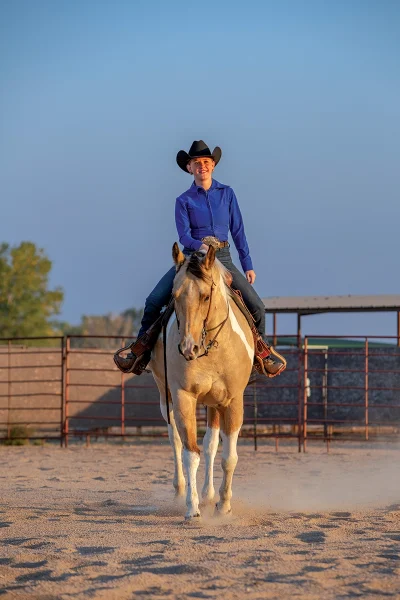
A young rider on a buckskin tobiano.
Photo by Heidi Nyland Melocco

Trainer Ariel Hug helps you position yourself for a perfect sidepass—just like you may see in a performance class. As an Interscholastic Equestrian Association (IEA) coach, Ariel prepares middle and high school students for western show events. She says sidepassing is often a skill needed for pattern classes as well as for ranch riding and trail events. Plus, it’s useful for opening gates while mounted or trail riding.

Here, she coaches Sophia Goetz and Gatsby to tune up their sidepassing cues while working at the fence line before lining up with the pole to cue for a plus-scoring sidepass.

Breaking Down the Sidepass

If you haven’t practiced sidepassing before, make sure to practice with a fence or solid wall in front of you to “close the front door” of the horse’s forward motion. This will help your horse tune into your cues and make sure he’s moving to the side. He is less likely to think you’re asking for a small circle.  

“The horse can only move sideways or back,” Ariel says. “This is what we do when we’re teaching a horse for the first time or if a horse is having trouble.”
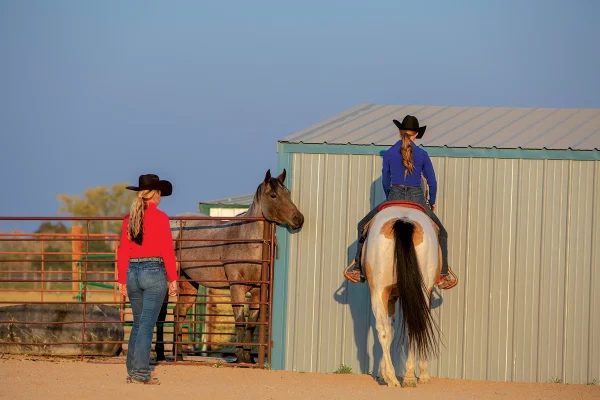
Using a wall in front of the horse to teach the sidepass.
Starting with a wall in front of you will help halt your horse’s forward movement as you learn the sidepass. Photo by Heidi Nyland Melocco

To cue your horse for a sidepass at the fence, ride with two hands and pull your horse’s nose to the opposite direction from where you want to go. If you want to move to the left, pull the horse’s nose slightly to the right with light rein pressure. Holding this position will help a horse to know that he should move to the side instead of circling with his nose in the direction of the turn.
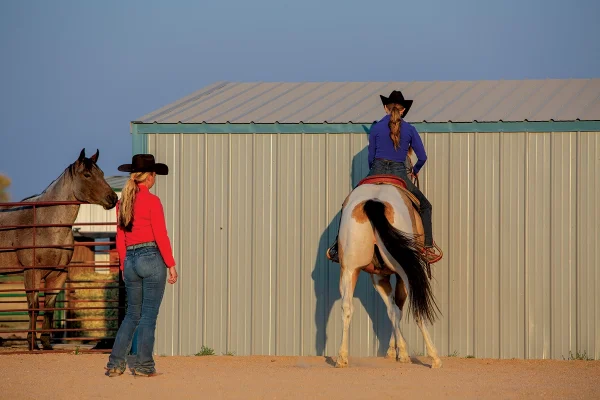
Using the wall to prevent any forward motion.
To cue your horse for a sidepass at the wall, ride with two hands and pull your horse’s nose slightly in the opposite direction from where you want to go. Photo by Heidi Nyland Melocco

Once your horse will easily step to the side and you don’t feel him wanting to move forward, practice in the middle of your arena with a pole to help you make sure you’re moving evenly to the side.

Pole Position

“Lining up well can make or break your sidepass over a pole,” Ariel says. “Line up the pole with the ball of your foot so you’re in the middle of the pole as you start, then pay attention to keep this position.”  
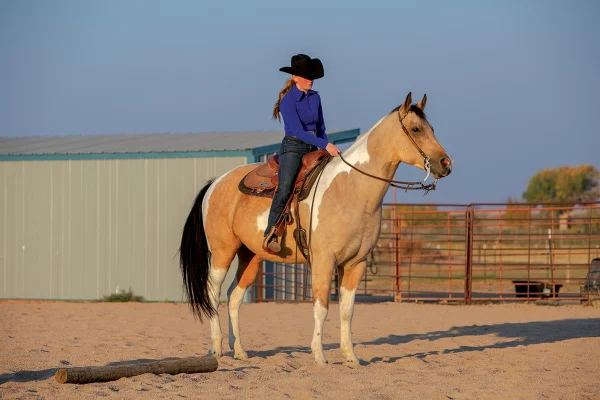
A young rider on a buckskin tobiano.
To sidepass over a pole, line it up with the ball of your foot. Photo by Heidi Nyland Melocco

To go to the right, gently bump your left leg as it hangs naturally against the horse’s side—not reaching back or forward. Using your leg, the horse moves away from pressure. 
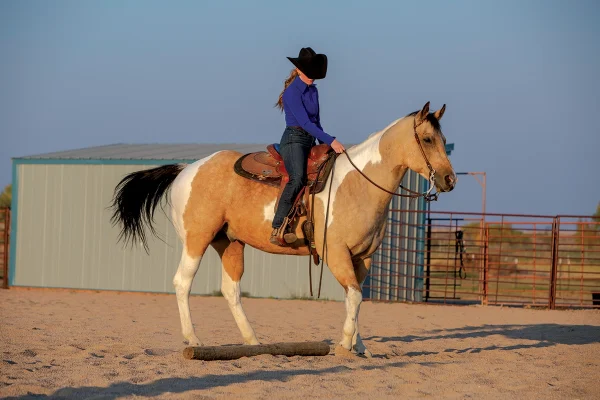
A young rider performing a sidepass on her horse.
Gently bump your opposite leg to move over the pole, not reaching your leg back or forward. Photo by Heidi Nyland Melocco

Use your aids to keep the horse centered over the pole and know if you need to move your hands forward to move the horse up or block the forward motion. 

“If you’re not lined up well, the horse will move forward or back over the pole,” Ariel says. “Even a trained horse will respond to your cues and can hit the pole if you don’t cue well.”  

If your horse’s shoulder moves too fast, move your hand back to slow the shoulder and keep it in line with the horse’s hip. If he moves forward over the pole, keep light contact and block the forward motion, ensuring that your cues obviously “open the door” to the side. If needed, you may move your cueing leg forward or back to ask the horse to move his shoulder or hip to get in line.

If it’s going well, practice the move from left to right, then go back over from right to left. If your horse is just learning the sidepass, make sure to master one direction first or offer a break before cueing the other way.

This article about teaching your horse to sidepass appeared in the January/February 2025 issue of Young Rider magazine. Click here to subscribe!

Heidi Melocco

Heidi Nyland Melocco holds a Bachelor's degree in English from Ohio Wesleyan University and a Master's degree in journalism from the E.W. Scripps School of Journalism at Ohio University with a concentration in magazine and photo editing. At the latter, she was named Master's Student of the Year. Her stories and photographs are seen regularly in many equine publications, including Horse Illustrated and Young Rider. Melocco is an author of Western Horseman's Understanding Lameness, Western Horseman’s Legends 6 and 9, and Goodnight’s Guide to Great Horsemanship, and she’s a contributing photographer for the Certified Horsemanship Association's Instructor Manual, Hitch Up & Go, The Revolution in Horsemanship by Rick Lamb and Robert Miller, DVM; and Breed for Success by Rene Riley and Honi Roberts. She and her daughter are currently writing a new children's book called Pony Powers—all about what it's like to keep a pony at home. Melocco's photos have won awards from the Equine Photographer's Network and an AIM Award. Melocco holds first-prize awards from American Horse Publications (AHP) for training stories and equine photography. She has had more than 35 magazine cover photos. Melocco continues to write about and photograph horses and also works in video broadcasting. She directed and produced a popular RFD-TV show for more than 10 years. Melocco stays up to speed with social media and has grown accounts to reach and engage with hundreds of thousands of fans. She served on the Board of Directors for the Colorado Horse Council and has presented social media seminars at the PATHi and CHA International Conferences.She started riding Ponies of the Americas at age 5 at Smiley R Ranch in Hilliard, Ohio, with Janet Hedman and the W. E. Richardson family. In college, she was president and later assistant coach of the Ohio Wesleyan University Equestrian Team, coached by world-champion-earning trainer Terry Myers. Keeping active as a rider and riding instructor, Melocco began studying Brain Gym—an international program based on whole-brain and active learning. As a 4-H advisor, she used the simple movements to help horseback riding students relax and achieve their goals in the saddle. Melocco became a registered instructor with Path International, helping to combine horse knowledge and therapeutic experience with horsemanship training. Melocco has presented demos at Equine Affaire and at the Path International and National Youth Horse Council Annual Conferences. She taught at the Colorado Therapeutic Riding Center in Longmont, Colo. Melocco resides on her small-acreage horse property with her husband, Jared; daughter Savannah; registered AQHA gelding, Charlie; pony, Romeo; dogs Lucy and Rosie, and three orange barn kitties known as the "Porch Patrol."

Tags

Leave a Reply

Your email address will not be published. Required fields are marked *

CAPTCHA Image