


When you are learning to jump and first starting to put courses together, often those courses are quite simple. They might include some single jumps plus lines set on the diagonal and the outside or quarter line. As you become better at setting your horse up straight and in the center of each jump, carrying a good rhythm in your canter, and counting strides, then your instructor will start to introduce new elements to your courses, one of which may be a bending line. Here, learn how best to ride one.
What’s a Bending Line?
A bending line is when one jump is set as if it’s part of an outside line, and another is set as if it is part of a diagonal line. It is also possible to have a bending line in which both jumps seem to be part of two different diagonal lines.
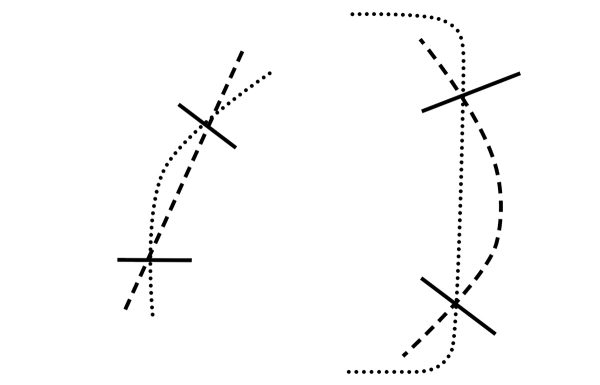
One of the most common exercises done with bending lines is practicing taking both the indirect track and the direct track. The indirect track means you are approaching each jump straight, negotiating the space in between the jumps by riding straight after the first jump in the line until you see the straight approach for the second jump start to appear. This is the track most often used when riding a hunter-style course, or in the first round of a jumper class when the focus is just to go clear.
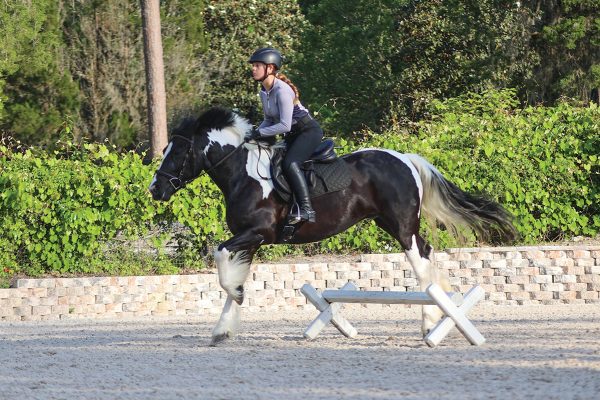
The direct track means that you jump one or both of the jumps on an angle in order to create a straight line in between the jumps. When you take the direct track and count the strides in between the jumps, that number will be one lower than the number of strides you get when you take the indirect track. This is the track used in the jump-off or speed round of jumper competitions.
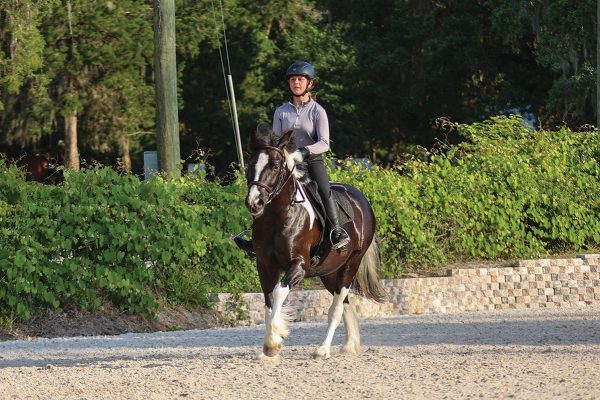
It is possible for either the indirect or direct track to be used in equitation courses, depending on the questions the course designer is asking of the riders.
Angling the Jumps
When considering whether to start practicing taking jumps at an angle, it’s important to wait until your jumping skills are correctly developed so that you’re confident in closing your legs around your horse, looking ahead to the next fence, and following your horse when he leaves the ground. You can always practice with poles on the ground instead. It’s also important that this is only done with experienced horses that don’t have a history of refusing or running out.
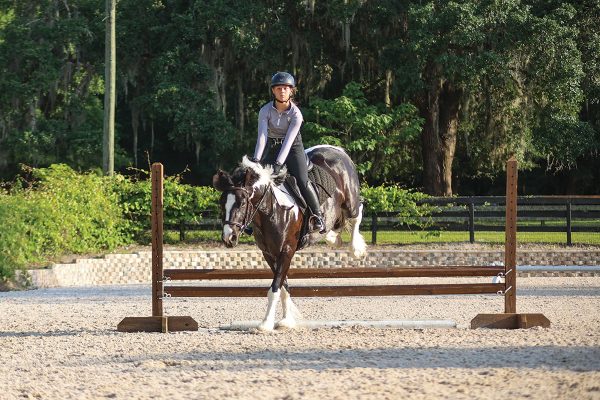
Although you are no longer approaching the jump head-on so that your horse’s body and the jump create the letter “T” (this is called perpendicular), you are still jumping the center of each fence and holding your horse straight on your chosen path.
This path may be what is called “left to right” (taking off to the left of center and landing to the right of center), or “right to left” (taking off right of center and landing left of center).
Many riders start to change their riding style in the approach, taking their leg off or being timid in their pace as they are unsure of asking their horse to do something new and different. In reality, if your horse is well-schooled to the aids, he will listen to the leg, seat, and hand telling him to leave the ground at an angle, and he won’t think twice about it. The confidence of most horses is directly linked to their rider.
Try It Yourself
A great way to practice taking the direct and indirect track is to set up two poles or small jumps in a bending line with 65 feet from center to center. Once you have warmed up, use an energetic rhythm to canter through the bending line, finding the indirect track that perpendicularly intersects each pole at the center, counting your strides. The number of strides you just did in the line is what you should use as your “original number.”
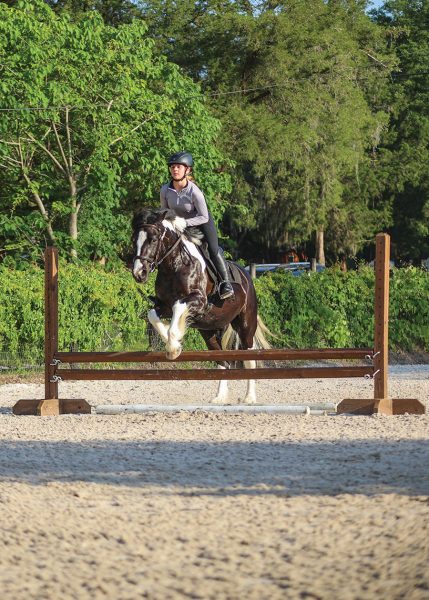
The next task is to do your original number, minus one, by taking the direct track. Your new skill of angling the approach can be used by riding from the center of one pole or jump to the center of the next in the shortest line possible, eliminating the stride in the middle of the line previously used to turn.
This new element of coursework will help you practice and put together numerous other skills, such as clear aids, having a focused eye while jumping, straightness, counting strides, and carrying a forward rhythm.
As a hunter, jumper, or eventer, you will encounter many courses and exercises that ask questions and require you to make a course plan at lessons, clinics, and shows. Understanding the multiple ways to negotiate a bending line will become an important part of your toolbox in these situations.
This article about how to ride bending lines appeared in the November/December 2024 issue of Young Rider magazine. Click here to subscribe!

