


Sometimes the history of a horse breed is strongly influenced by one particular animal. This was the case with Figure, the foundation stallion of the Morgan breed, and the mare Old Granny, the foundation mare of American Cream Drafts. In Thoroughbreds, there were three notable foundation stallions: the Darley Arabian, the Godolphin Arabian, and the Byerly Turk. In other cases, it’s an individual human that is deeply important to the history of a horse breed. And that’s the case with the Orlov Trotter.
You can’t tell the story of the Orlov Trotters without talking about Count Alexei (sometimes spelled Alexey or Aleksey) Orlov of Russia. Count Orlov was born in 1737 and lived until 1808, serving in the Russian military during the time of Catherine the Great.
History tells us that after Count Orlov retired from his military career, he was able to pursue his interest in livestock breeding, and it’s been said that he developed or refined an impressive number of livestock breeds during his lifetime.
Of these, the most famous are both named after him: a chicken breed called the Russian Orloff and a horse breed called the Orlov Trotter.
A Fast and Fabulous Trotter
Count Orlov obtained a gray Arabian stallion named Smetanka, along with other Arabians, and they played an important part in the makeup of Orlov Trotters. Some history indicates that Count Orlov paid a very high amount of money for Smetanka, while other sources say Smetanka was given to Count Orlov as a gift.
According to the website for Moscow Stud Farm No. 1 (which still raises Orlov Trotters today), Smetanka was hand-walked all the way from the Middle East to Count Orlov’s farm Moscow in 1775—at least 2,000 miles!
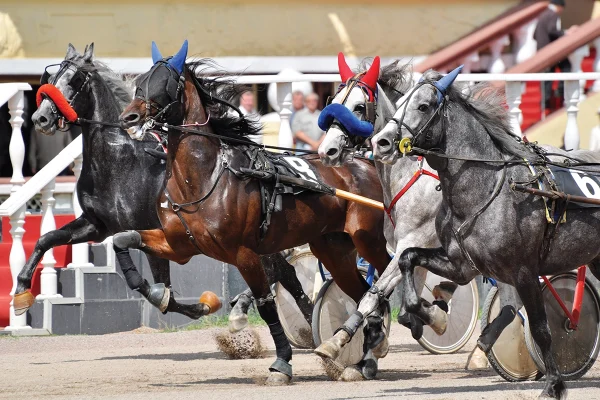
Count Orlov’s vision in the 1770s and 1780s was to combine Arabian bloodlines with Dutch and Danish horses, as well as other select breeds, to develop a superior trotting horse for harness racing.
Smetanka only lived long enough to sire a few foals, but his grandson, Bars I, became an influential sire of Orlov Trotters. As the years passed, the Orlov Trotter’s talent in harness and its impressive trotting ability became well known and admired throughout Europe and abroad.
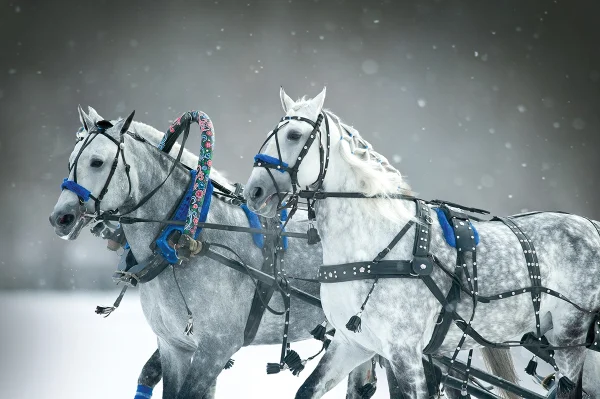
Eventually, the popularity of Orlov Trotters in the harness racing world was somewhat overshadowed by the fame and success of the American Standardbred, but some farms in Russia and the Ukraine still breed Orlov Trotters today.
The breed is rare in North America right now, but increased awareness of the Orlov Trotter’s impressive athleticism, stamina, and gentleness could introduce new people to the breed.
Famous Orlov Trotters
The most famous Orlov Trotter was undoubtedly Balagur, but he wasn’t famous for harness racing—he was talented in dressage! In his younger years, Balagur was a police horse, but it was in dressage that he truly found his calling.
Balagur competed at the 2004 Olympics in Athens and the 2008 Olympics in Beijing, where he placed 6th in individual competition at the age of 18. Balagur was particularly known for the high quality of his piaffe.
After his retirement from competitive dressage, Balagur became a valued lesson horse and was notably sound even in his older years. He passed away in 2019 at the age of 29.
Nature’s Ballet was another highly accomplished Orlov Trotter. In the 1970s and 1980s, Nature’s Ballet competed five times in the 100-mile Tevis Cup race, held each year in California.
It’s easy to see that Orlov Trotters have superior athleticism, a fascinating history, and a bright future ahead of them. Maybe one day you’ll ride or drive an Orlov Trotter and discover for yourself why this breed has endured for nearly 250 years!
Orlov Trotter Fast Facts
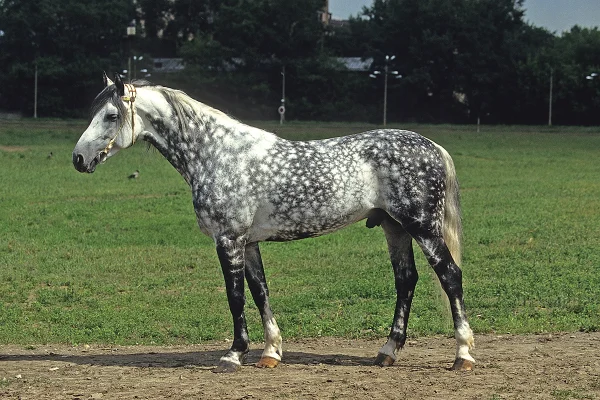
◆ The average size of Orlov Trotters is 15 to 16 hands high.
◆ Orlov Trotters are often gray, but black is also common, and bay and chestnut are sometimes seen.
◆ Orlov Trotters are known for their trot, but in addition to being incredible in harness, they’re also talented in other disciplines as well, including dressage, endurance, trail riding, and jumping.
◆ There’s no registry for Orlov Trotters in North America, but some horses may be eligible for registration with the Orlov-Rostopchin Sporthorse Association.
This article about the Orlov Trotter appeared in the November/December 2024 issue of Young Rider magazine. Click here to subscribe!

