


This ground pole exercise may seem easy at first glance, but it will challenge you and your horse to find proper balance and a consistent rhythm at the canter. It’s also a great introduction to making some tighter turns, both on the flat and over fences.
The Set-Up
To set this exercise up, measure a circle that is 30 feet from the center all the way around, with poles placed at the four main points of the circle (12, 3, 6, and 9 o’clock). The inside edge of the pole will sit at the 30-foot mark, so that when you’re riding the circle over the center of the poles, you will be riding closer to 35-36 feet from the center. If you don’t have a measuring tape, you could also use the length of a longeline to guide you in making the circle.
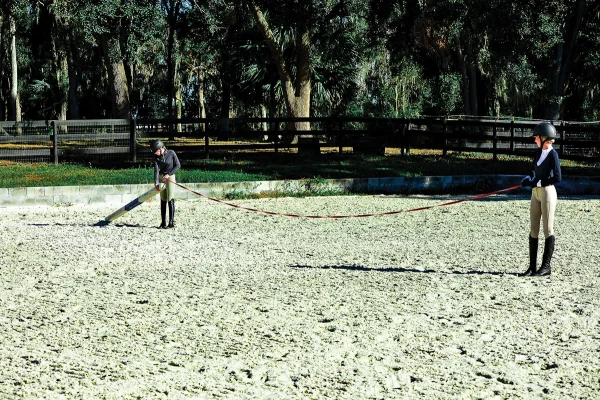
After you get on your horse and warm up, it’s time to introduce him to the ground pole circle you’ll be using for this exercise. Start at the walk so that you get familiar with how the turns ride as you go over the poles, center to center, around the circle.
Then move up to the trot, being sure to keep an inside bend and riding a consistent circle without your horse falling in or out on the circle. Once you feel ready, it’s time to try it at the canter.
Two Poles at a Time
Riding the circle can feel quite different at the walk and trot versus the canter, as the turns come up much quicker. The best way to begin is to pick two of the poles and start with just one turn at a time. This way you can get used to the track you need to ride and the number of strides that suits your horse best.
To be successful, your horse can’t be leaning forward and down into his inside shoulder, and instead must be rocked back onto his hindquarters, especially the outside hind.
Your body should mimic what you expect your horse to be doing, with your inside shoulder pulled back, your inside hand slightly lifted, and your weight slightly more in your outside seat bone.
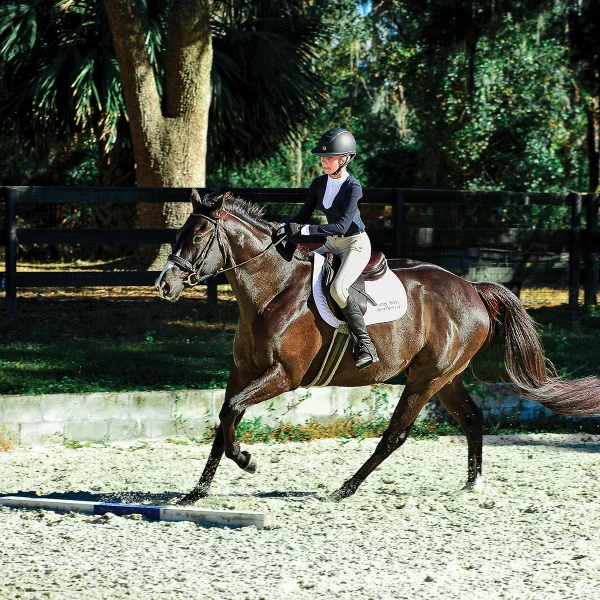
To start, your horse will likely be better off doing more steps in a collected and balanced canter than fewer steps in a longer stride.
Three and Then Four Poles
Once you have established what striding works best for your horse, you can move to riding three of the four poles, and eventually all four.
Cantering on a circle is a lot of work for your horse, so be sure to give him lots of breaks, and possibly even break up this exercise across multiple rides so that both of you have the time to improve and tackle it fresh.
In the beginning, many riders find it difficult to maintain the consistency needed in this exercise. Dial in your focus and keep your body lifted and in position around the circle. Keep your fingers closed on the reins and your elbows by your sides to keep your horse’s front end lifted. Sit deep in the saddle to keep the horse pushing from behind, with your legs helping to keep him exactly in the center of the poles.
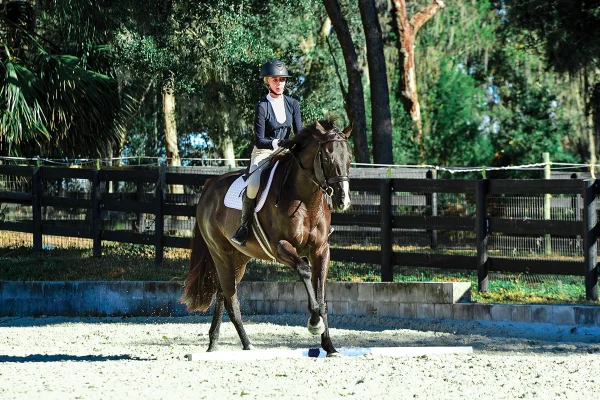
The ideal execution of this exercise is to be able to go around the circle twice, getting the same number of strides between each pair of poles.
Raise the Poles
If you and your horse were super successful with this exercise, you can start to add in some raised cavalletti or small jumps. The jumps for this exercise should never be bigger than about 18 inches, and I highly recommend starting with raised cavallettis or cross-rails so that you and your horse can get your bearings safely.
Build the exercise up the same way with one quarter of the circle at a time, or you can even start with just two jumps on the circle directly across from each other, at 9 and 3 o’clock or 12 and 6 o’clock.
You may have trouble with this exercise and find it really challenging, and that’s OK! Is your horse falling in or out on the circle consistently? Make sure that you are using your leg to keep him on the circle. Maybe your horse needs a tune-up to be reminded to listen to your leg on that side.
Does your horse drag you down and forward after three to four poles, so you can’t seem to make it twice around the circle? Make sure that both of you are strong enough for this exercise, practicing transitions and working on strengthening your core when you’re away from the barn.
This can be a great “check-in” exercise—one that you do every three to six months to see how you have improved!
This article about a ground pole exercise appeared in the March/April 2025 issue of Young Rider magazine. Click here to subscribe!

