


Discover some of the rarest horse colors and the genetics behind them.
When Rebecca Bellone was in college in the 1990s, she took a class on livestock genetics. The professor showed a picture of a spotted Appaloosa, and revealed to the class that they didn’t currently understand how Appaloosas passed down their white patterning from parents to foal.
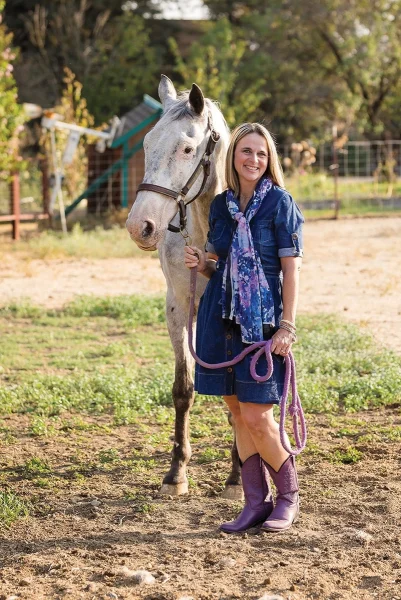
Rebecca thought the Appaloosa was the most beautiful horse she’d seen, and soon bought one of her own. She also decided to become a scientist to study equine genetics, particularly pigmentation.
She now holds a Ph.D. from the University of Kentucky and directs the Veterinary Genetics Laboratory at University of California, Davis. The lab tests horses and other species to verify their parentage, rare coat color genes, and more.
Refresher: Understanding Genes
There are two copies of each gene in your (or your horse’s) DNA, one from the mother and one from the father. Dominant genes—abbreviated with a capital letter, such as A—show outwardly in an animal’s appearance (“phenotype”) whether you have one copy or two. This would be the “genotype” AA or Aa.
To show a recessive gene’s phenotype, you must have both copies—aa—because dominant genes “cover up” the outward appearance of a recessive gene.
Color Gene Basics
All horses are either black-based or red-based, determined by an extension gene (“E”) and the agouti gene (“A”). The dominant version of the extension gene (“E”) is responsible for creating a black base, while the recessive version (“e”) is responsible for creating a red base. (See “Gene Basics” sidebar if you’re not familiar with dominant and recessive genes.)
“The dominant version of the agouti gene (‘A’) limits black pigment on a black-based horse to the points, whereas the recessive version of agouti (‘a’) results in an all-black phenotype on horses with two copies,” Rebecca says.
Tammy Canida, registrar at the American Quarter Horse Association (AQHA), explains that a horse with a black base that has the dominant version of agouti will come out bay, where the black is limited to the points of the mane, tail, lower legs, ear tips and muzzle.
While black, chestnut and bay are all common colors and easy enough to understand, what makes those rare colors like champagne, smoky cream, perlino, and others?
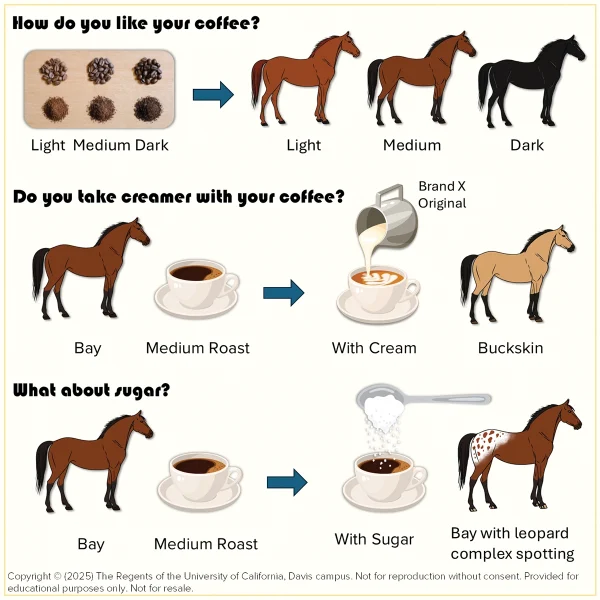
There are several hundred genes that contribute to coat color, and they interact with each other, so it can be very complicated. But Rebecca has an easier way to explain it. Imagine you’re going to the coffee shop with one of your parents.
“I equate the base colors of black, red and bay to roasts of coffee,” she explains. “A black horse is a dark roast coffee, a bay horse is a medium roast coffee, and a chestnut horse is a light roast coffee.”
Those base horse colors can then be diluted by certain genes to create other colors. Thinking in terms of coffee, after you’ve chosen your roast, you can then add creamer, and there are lots of different brands and types of creamers.
“Think of all of those different kinds of creamers as specific genes that dilute that base coat color,” Rebecca explains. “So a specific brand of creamer added to a bay horse can produce a buckskin. You could take that same brand of creamer and add it to a chestnut horse, and you would get a palomino. That’s the basics of base coat colors plus those genes that contribute to dilution.”
The last decision in the coffee shop is which type of sweetener to add. Rebecca says the sweetener is the addition of white. White is the absence of pigment (color).
“A buckskin Appaloosa is going to be a medium roast coffee with one dose of a particular kind of creamer and one helping of sugar,” she says.
Rare Horse Colors
The American Quarter Horse Association recognizes 23 horse colors. Some of the rarer colors include variations of champagne. Champagne can dilute black to brown or red to gold, creating classic, gold, or amber champagne. Champagne horses have pinkish/lavender-toned skin that speckles with age and amber or hazel eyes.
True white is the rarest recognized AQHA color. True white horses have white hair all over their bodies with dark eyes.
“Most of these are likely caused by different variations in a gene named KIT,” Rebecca explains.
The American Paint Horse Association (APHA) recognizes 20 approved horse colors. Rarer colors in AQHA and APHA horses include cremello, perlino, grullo and smoky cream.
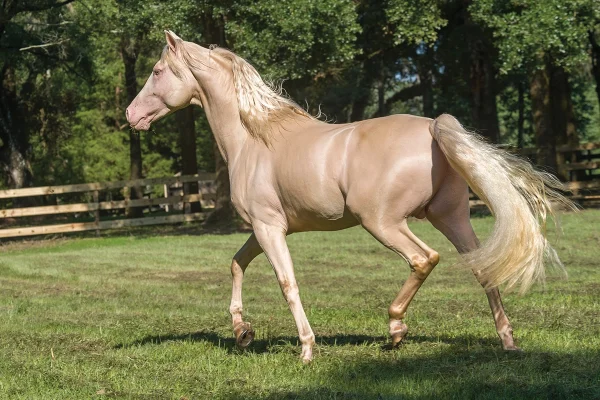
Cream is the name of the dilution gene that causes palomino, buckskin, cremello, perlino, smoky cream and smoky black coat colors.
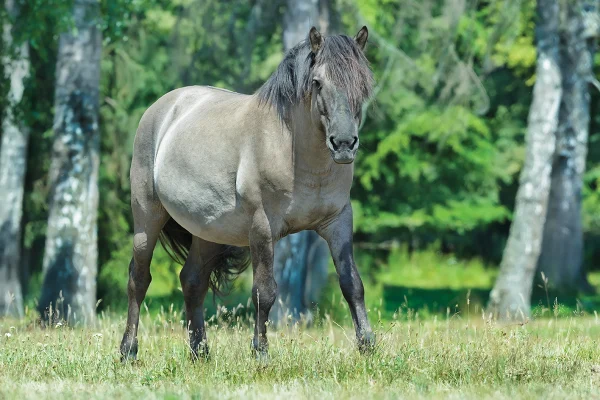
Grullo horses are part of the dun family of colors. They are tannish-gray with darker manes and tails.
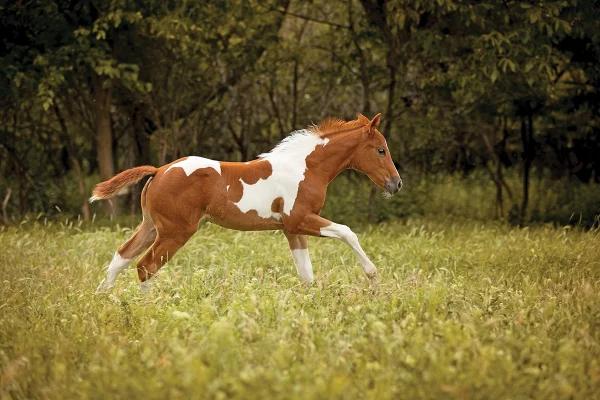
Paint Horses come in a variety of white-splashed coat patterns, including tobiano. A rare “slipped tobiano” doesn’t show many spots, but because the horse still carries the tobiano version of the gene, it can produce a tobiano colored foal, explains APHA Senior Director of Communications Jessica Hein.
You won’t find the mushroom color in APHA or AQHA horses, but you’ll often see it in Shetlands and Miniature Horses. The mushroom variant dilutes a chestnut or red background horse to a sepia color. Because it is recessive, it must be inherited from both parents. These horses show a reddish-brown coat color, often with a flaxen mane and tail.
But Rebecca’s favorite coloring is still Appaloosa, also known as leopard-complex spotting. These patterns are one of the oldest known coat color mutations. The Appaloosa color gene is dominant, so it only has to be inherited from one parent. If it’s inherited from both parents, the resulting horse will have a condition known as congenital stationary night blindness.
Rebecca’s team recently discovered a new color mutation known as splash white 8, since it was the eighth genetic variant found to explain a similar appearance. It was found in a Thoroughbred foal that looked like it splashed around in white paint, but neither parent had a white spotting pattern.
Learn more about rare horse colors and genetics at vgl.ucdavis.edu/dna-tests/horse.
This article about rare horse color genetics appeared in the May/June 2025 issue of Young Rider magazine. Click here to subscribe!

