


The majestic Lipizzan is recognized all over the world for its beauty and talent, historically in the world of classical dressage, as well as in a wide range of disciplines today. These baroque-type horses are incredibly impressive with their nobility, strength, and intelligence, and their fascinating history is just as noteworthy.
The Lovely Lipizzan
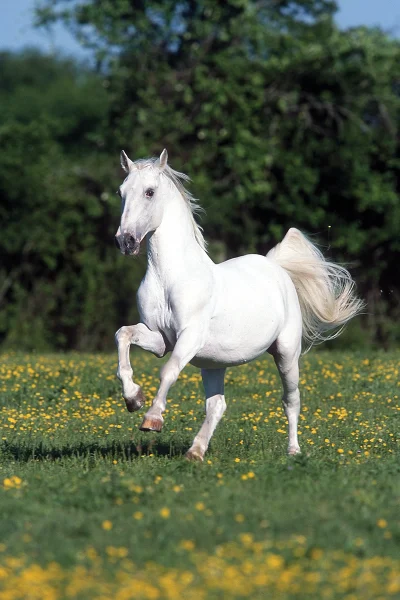
The first thing most people notice about Lipizzans is that they’re almost always a beautiful pure white. And while it’s true that they look white, technically they are gray.
Gray horses are born dark, and as they get older, their coats become lighter and lighter. If you ever have the chance to see a Lipizzan foal, you’ll discover that the foals are born bay, black, chestnut, or sometimes dun, but this color only lasts a short time, and they continue to lighten as they age. (Not all adult Lipizzans are gray, as you will occasionally see dark-colored adults.)
Mature Lipizzans are strong and capable horses that mature to around 15.2 hands in height. They’re known for being athletic and muscular, with arched necks, large eyes, and gentle expressions.
The Birth of the Breed
The history of these amazing horses dates back about 450 years. In the late 1500s, Archduke Charles II of the Austro-Hungarian Monarchy began breeding horses that became the foundation of the Lipizzan breed.
His stud farm was located in the city of Lipica (or Lipizza in Italian), which is where the breed gets its name. The monarchy purchased Spanish horses to further establish the herd, and they likely also used local Karst horses in the development of the Lipizzan. The famous Spanish Riding School (located in current-day Vienna, Austria) was also established in the 1500s.
At the beginning of the 18th century, additional breeds were brought to the Lipica Stud Farm to further develop on the foundation provided by the Spanish horses. Some of these new horses came from Italy, Germany, Denmark, and other countries. Later, Arabians were also brought to the farm.
War-Torn History
A series of wars involving Napoleon at the end of the 18th and beginning of the 19th centuries caused a lot of turmoil in the Lipizzan breed. The horses were repeatedly evacuated during those years.
But even though the Lipizzans faced many hardships, the breed endured. After the evacuations, the horses would return home, but sometimes a few horses stayed behind to begin new Lipizzan stud farms throughout Europe. Today, there are breeding farms in Austria, Slovenia, Italy, Romania, Slovakia, Hungary, Serbia, and Croatia.
World War I and World War II were very precarious times for the Lipizzans, and the horses were dispersed to various parts of Europe for their safety. After WWI, the herd at Lipizza was divided between Italy (who now controlled Lipizza) and Austria. That is when Austrian Lipizzan breeding moved to the Piber Federal Stud.
When WWII started, Italy moved their herd of Lipizzans to Monterotando, outside of Rome. As the war neared its end, the Lipizzan horses were again in grave danger, and Alois Podhajsky of the Spanish Riding School in Austria asked for help from U.S. Army General George S. Patton.
The Spanish Riding School had begun giving dressage performances to the public featuring the amazing Lipizzan stallions, and while their safety was in jeopardy, the Lipizzans gave an impressive dressage performance for Patton inside a riding hall.
Their rescue, called “Operation Cowboy,” was soon underway. Hundreds of Lipizzans were successfully rescued and moved out of harm’s way, thus saving the breed. As a thank you, Patton was shown a second performance by the horses after the rescue.
After World War II ended, Lipizza became part of Yugoslavia and they had to completely rebuild their breeding herd. Some horses went back to Austria, and some moved to Germany or the United States. Today, the city of Lipica/Lipizza is now a part of Slovenia.
The Lipizzan Breed Today
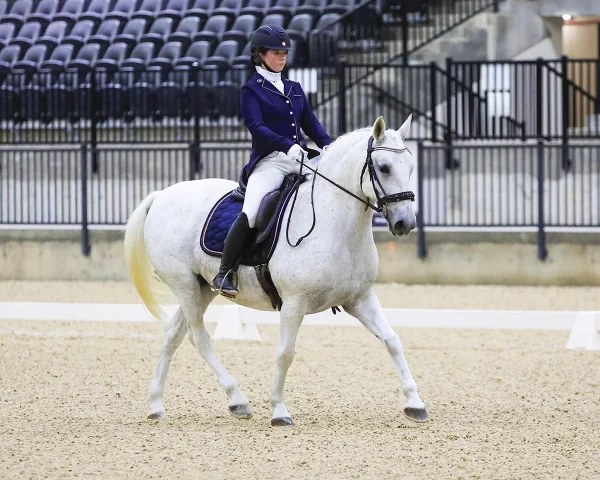
While modern-day Lipizzans are still famous for their dazzling dressage abilities, they’re also used as driving horses. Some even enjoy jumping. Thanks to their athleticism and intelligence, they’re excellent in a variety of disciplines, including working equitation, mounted archery, eventing, working cattle, trail riding, and more!
The overall population of Lipizzans worldwide is over 11,000, but the population of Lipizzans in the United States is just under 900. This number may continue to drop due to the low number of foals being born each year.
Joining the Fun
The United States Lipizzan Foundation (USLF) works to preserve, protect, and promote the Lipizzan breed in the United States. While they don’t offer specific programs for youth, they aim to be very welcoming of youth who are interested in the breed. They strive for a youth-friendly culture in all of their programs, and they offer a wide variety of awards programs.
One of these programs, called “Lovin’ our Lipz,” has a tiered reward system that includes activities for riders of all levels, experience, and interests. This could include mucking stalls, doing historical research, spending time with your horse, going on a trail ride, or journaling about your time together.
The USLF also offers high-point awards, year-end awards, lifetime achievement awards, U.S. Dressage Federation/USLF All-Breeds Awards, and more. There’s something for everyone who loves the Lipizzan breed!
The USLF also recognizes that not everyone can own a Lipizzan, so they offer an “Enthusiast Membership,” which includes their quarterly magazine—the perfect option for anyone who wants to daydream about Lipizzans.
Lipizzan Fast Facts
◆ The Lipizzan breed achieved significant fame because of the 1963 Disney film, Miracle of the White Stallions.
◆ These baroque-type horses are known for their skill in classical dressage.
◆ Lipizzans are almost always gray (white hair with black skin underneath), but other colors such as bay, brown, black, and dun are sometimes seen.
◆ Lipizzans are said to be recognized as a national animal of Slovenia.
◆ Lipizzans are known for their highly technical “airs above the ground” dressage movements, which require years of training.
◆ The ideal height for a Lipizzan is 15.0 to 15.3 hands at the withers, but some variation is seen, both shorter and taller.
◆ The United Nations Educational, Scientific and Cultural Organization (UNESCO) has officially recognized the “intangible heritage” of the Lipizzan and its cultural importance in a number of countries.
◆ If you can’t remember how to spell Lipizzan (does it have two P’s? Two Z’s?), just remember the name has “pizza” in the middle!
If you’re ready to learn more about this historic and awe-inspiring breed, then don’t delay. To explore the world of Lipizzans or to join USLF, visit www.uslipizzan.org to get started.
This article about the Lipizzan appeared in the March/April 2025 issue of Young Rider magazine. Click here to subscribe!

