


When explorers Meriwether Lewis and William Clark embarked on their historic trek across the United States in 1804, they witnessed some of the great natural beauty that the country has to offer, but they also saw something else: the ancestors of Appaloosa horses.
The Nez Perce Native American tribe had prized these spotted horses since the 1700s. They were originally called “Palouse horses,” after the Palouse River in Idaho and Washington. Over time, the name Palouse horse turned into the word Appaloosa. Lewis made note of these spotted horses in his writings, describing them as “active” and “excellent.”
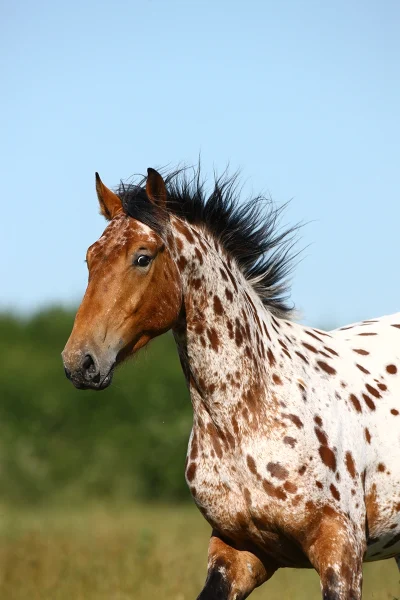
Today, the Appaloosa is the official State Horse of Idaho, and it has galloped into the hearts of horse enthusiasts everywhere. Let’s take a closer look at this legendary breed.
Great for Youth
Many modern Appaloosas have a western stock horse appearance, influenced over time by American Quarter Horses and other breeds. Appaloosas have long excelled at trail riding, barrel racing, reining, cutting, and western pleasure, but they are also quite suitable for English disciplines like jumping and dressage.
Appaloosas are athletic and talented, with the temperament to shine in a wide range of performance classes, and their size—usually 14 to 16 hands—makes them popular with adult and youth riders alike.
In 1938, The Appaloosa Horse Club (ApHC) was established, and since then, they’ve registered over 700,000 Appaloosas. Youth members are a big part of the ApHC’s focus, and if you’re interested in getting involved with the breed as a youth member, you’re in luck!
The Appaloosa Youth Association (AYA) has nearly 1,000 youth members who participate in a variety of programs and activities. The best news is that there’s always room for more participants!
According to Rachel Daugherty and Hannah Ruth Pettyjohn, youth coordinators of the ApHC, some of the most well-known and popular activities are those offered at the World Championship Appaloosa Youth Show, held annually in Oklahoma City, Okla., in conjunction with the National Appaloosa Show.
Youth exhibitors can compete in a wide range of halter and performance classes, including showmanship, equitation, horsemanship, pleasure, trail, reining, walk-trot, and many more. The AYA offers a Champion of Champions class, in which the top competitors from specific classes are chosen to compete against each other in the show ring using their own patterns, music, and style, Daugherty says.
“At the Youth Worlds, we are also proud to offer activities that youth can participate in beyond their show classes,” says Pettyjohn. “This year, some of those include adult versus youth dodgeball, a barn dance, a parade of states, the AYA Olympics, some scavenger hunts, a dog fashion show, an ice cream social, and more.”
They also hold fundraisers during the show, and this year, they’re raffling off a hoverboard!
Lots of Activities
But the fun extends beyond the World Championship show. The AYA offers a Saddle Log Program to track your hours spent in the saddle, an All-Breeds Activities Program that allows you to earn points for local open competitions, art contests, photography contests, scholarships, year-end awards for horses and riders, and tons of games and activities.
One of these is the annual week-long Chief Joseph Trail Ride from Jackson, Mont., to Leadore, Idaho.
“This trail ride is offered to the entire ApHC, which includes youth members,” says Pettyjohn. “It is a great way to learn and honor the heritage of the horse as it follows the trail Chief Joseph lead his people on.”
The AYA also offers free bimonthly events held online—and you don’t have to be an AYA member to attend. At these events, they offer workshops with guest speakers, seminars, panels, contests, and fundraisers. The events usually have prizes, too.
“Our youth directors get to decide what we do every other month, and they’re always coming up with fresh ideas,” says Pettyjohn.
Becoming a youth director can be a great goal if you’re interested in becoming more involved with the AYA. Even new members are encouraged to run for the board, and it can be a great way to experience personal growth and leadership.
You can also get started at the regional level and begin attending AYA events.
“These are two of the best ways to connect with more Appaloosa youth members,” says Daugherty. “New members are even encouraged to run for the AYA Board of Directors, where they can to contribute their thoughts and ideas to what events the AYA offers, what activities happen at the World Show, and, of course, meet and befriend more Appaloosa youth members.”
If this sounds like fun, why not step into the world of Appaloosas and see for yourself? Those eye-catching coat patterns are just the icing on the cake!
Appaloosa Patterns
Physical characteristics of the Appaloosa breed include striped hooves, white sclera around the eyes, and mottled skin on the face. But the true draw for lovers of this breed is the infinite variety of spotted coat patterns—they’re like snowflakes, no two are exactly the same!
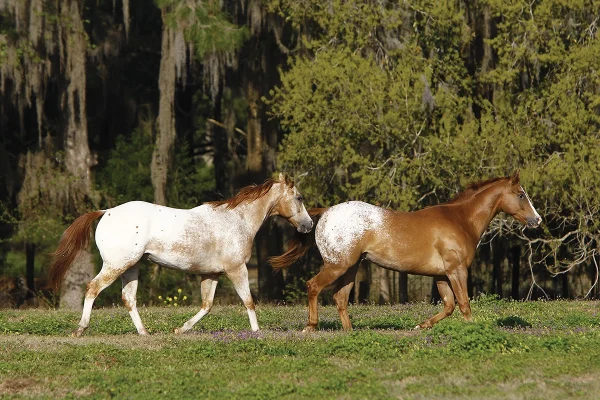
The Appaloosa Horse Club (ApHC) recognizes 13 base coat colors and a variety of coat patterns, including:
- Spotted Blanket: A solid coat with a spotted white hip blanket.
- Snowcap: A white hip blanket, but without the spots.
- Varnish Roan: White hairs scattered throughout the horse’s coat create a roan-like appearance, often getting lighter with age, while darker “varnish” markings appear over bony areas like the face, knees, and hips.
- Leopard: A white base coat covered in dark spots, like a Dalmatian.
- Snowflake: A dark base coat with lighter spots—basically the opposite of the leopard pattern.
- Frost: Smaller, more uniform white specks than snowflake, creating a roan-like appearance with white hairs scattered throughout.
- Solid: A horse that is a solid color without spots.
To get started and learn more, visit the Appaloosa Horse Club website or visit the AYA on Facebook or Instagram.
This article about Appaloosa appeared in the September/October 2025 issue of Young Rider magazine. Click here to subscribe!

