


In barrel racing, practicing the pattern over and over can get boring to your horse, so it’s best to mix up your sessions with other exercises that will benefit the pattern. I like to break my barrel training program up into sections that include foundation and advanced horsemanship training, power exercises, conditioning exercises, pattern work, and problem solving.
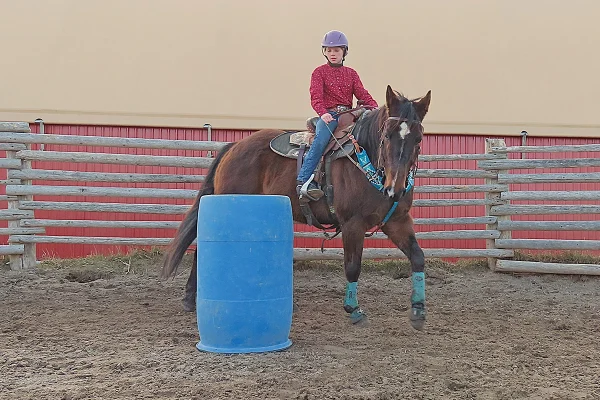
Square Turns to Stay Sharp
One horsemanship exercise that I like to do with my barrel horses is riding squares. If a horse rides a lot of circles, he can begin to get a little lazy in the turn and lose form. This can cause him to swing his haunches to the outside of the circle, especially at speed.
To circle correctly, the horse should circle with his front feet and back feet traveling in the same tracks around a circle to keep his power. To improve circles, I practice riding squares.
At the walk, I ride a straight line. At the corner of the square, I turn a 90-degree (right) angle. During the turn, I want the horse’s front end to move freely and his back end to be the pivot point.
To cue with my reins, I pull a little on the inside rein to turn the horse’s nose slightly. The outside rein stays steady to help keep the horse’s neck from overbending to the inside of the square.
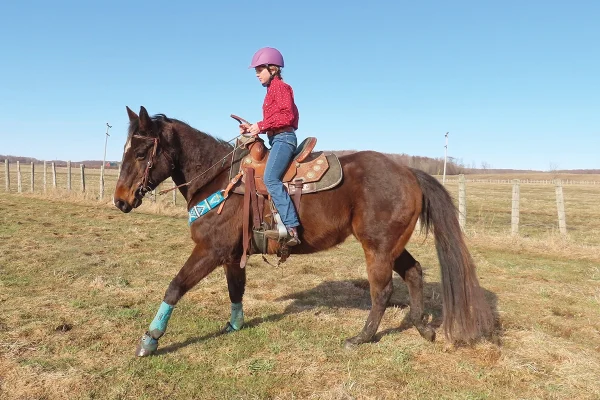
With my outside heel in a forward position (about 1 to 2 inches forward from where it normally hangs), I push the horse’s shoulders across to help him swing freely in the front end. His inside hind hoof is the pivot point of the turn, so at the corner, his hoof plants into the ground and rotates through the turn.
During the trot and lope, his inside hind hoof will have to move a little bit, but it will still be the main turning point.
Rollbacks for Power
Another type of exercise I work on is a power exercise. This type of exercise is higher intensity and done for short periods of time, similar to the time of a barrel racing pattern. This helps to develop big bursts of power and speed.
My favorite power exercise is the rollback. A rollback is a fast change of direction where a horse travels forward, turns 180 degrees by pivoting on his haunches, and then powers out of the turn to travel back on the same track he just came from.
To train a rollback on your horse, it’s best to use a fence or wall in the beginning. At a walk, travel parallel to the wall, staying about 4 feet from it. Then come to a stop and start backing your horse up. As the horse is backing, look over your shoulder that is closest to the wall, turn the horse’s nose toward the wall with your inside rein, and use your opposite heel in a forward position to push his front end through the turn.
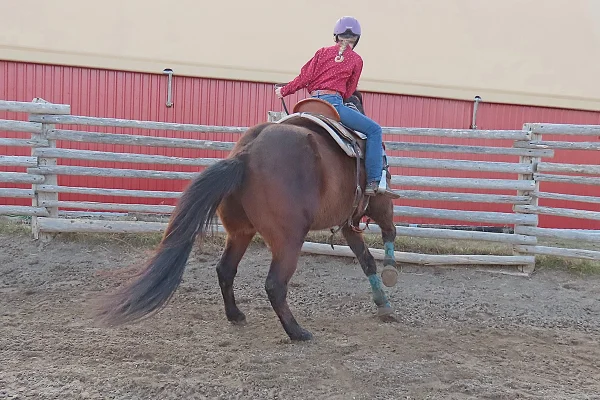
His hind end will be the pivot point. Now you will be heading back in the direction you just came from. The goal of the rollback is to have the horse’s haunches loaded with power so he can explode out of the turn, pushing hard with his hind legs.
In the beginning, I encourage adding in a backup in order to help put the horse’s weight on his haunches. After you and your horse develop the muscle memory for the rollback, take out the backup and pick up some speed going into and out of the rollback.
If your horse starts moving his haunches around, slow him back down and add the backup back in so that the muscle memory is properly developed again. Eventually, you will be able to really power out of the barrel turns if you have a horse that can rollback quickly and correctly.
Long Trot for Fitness
Conditioning is very important in any speed event so that you can be competitive, but also to prevent injuries to your horse. Conditioning exercises are done at a lower intensity for longer periods of time.
One conditioning exercise you can work on is the long trot. The long trot is when the horse reaches more forward at the trot than he normally would, covering more ground with an extended stride, as opposed to speeding up by just taking faster small strides.
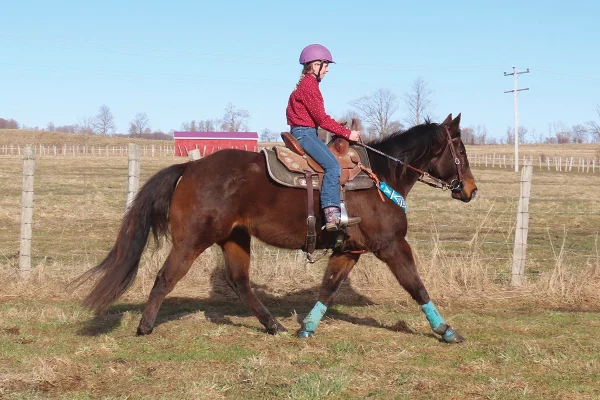
At your horse’s normal working trot, ask for him to reach out more. A field is the easiest place to do this. Depending on your horse’s fitness, start with short sessions, such as five to 10 minutes, and then slowly increase up to 20 minutes (or more), adding in walk breaks as needed.
Problem Points
Lastly, problem solving will always be a part of every barrel racing training program. My best problem-solving advice is to try to figure out what point on the pattern the horse is having trouble with and work on exercises away from the pattern that will help fix that problem.
For example, if your horse is not turning well, do turning exercises without working on the pattern. A lot of problems are not pattern problems, but rather horsemanship and training problems.
Just remember there are many exercises that you can work on to really improve your barrel pattern without burning your horse out on the pattern. I wish you all the best in your barrel racing training!
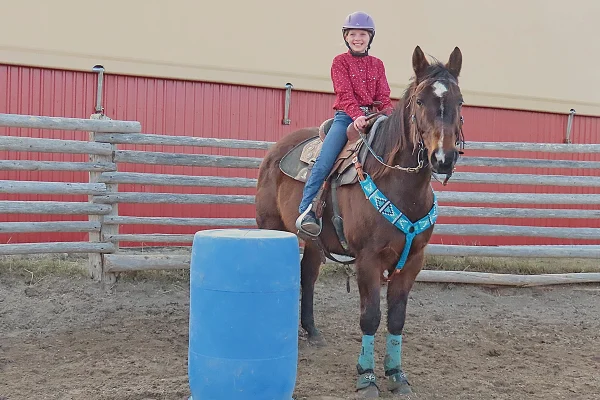
This article about barrel horsemanship training appeared in the July/August 2025 issue of Young Rider magazine. Click here to subscribe!

